
SDOH AND HEALTH OUTCOMES
Skin Cancer and Chronic Skin Conditions Study
Two complementary projects examine skin health: an aggregated survey of skin cancer and chronic skin conditions, and an All of Us v8 analysis of medication-associated skin-cancer patterns using machine learning and molecular modeling.
Interpretation: These projects use different populations and methods. Survey results are self-reported and aggregated; drug associations are observational and do not establish that a medication causes skin cancer.
STUDY OVERVIEW
Available survey domains
ALL OF US v8 · MACHINE LEARNING · MOLECULAR MODELING
Drug-Associated Skin Cancer Patterns
This observational project evaluated commonly prescribed medications and medication combinations in relation to malignant skin-cancer outcomes. The workflow combined All of Us v8 cohort analysis, relative and absolute risk estimates, photosensitivity characteristics, random-forest and gradient-boosting models, SHAP interpretation, and molecular modeling.
Drug-level participant counts and reported relative risk
| Drug | Therapeutic category | Participants | Reported RR |
|---|---|---|---|
| Levothyroxine | Thyroid hormone supplement | 37,984 | 7.27 |
| Simvastatin | HMG-CoA reductase inhibitor | 31,718 | 7.42 |
| Rosuvastatin | HMG-CoA reductase inhibitor | 24,017 | 7.78 |
| Omeprazole | Proton pump inhibitor | 80,381 | 8.95 |
| Atorvastatin | HMG-CoA reductase inhibitor | 77,939 | 9.13 |
| Metoprolol | Beta-blocker | 61,366 | 9.26 |
| Losartan | Angiotensin II receptor blocker | 36,823 | 9.33 |
| Fluticasone | Inhaled corticosteroid | 91,760 | 9.55 |
| Prednisone | Systemic corticosteroid | 93,191 | 9.66 |
| Duloxetine | SNRI | 27,212 | 9.79 |
| Hydrochlorothiazide | Thiazide diuretic | 56,363 | 9.87 |
| Lisinopril | ACE inhibitor | 63,841 | 10.02 |
| Escitalopram | SSRI | 26,569 | 10.05 |
| Montelukast | Leukotriene receptor antagonist | 24,146 | 10.16 |
| Fluoxetine | SSRI | 23,512 | 10.24 |
| Pantoprazole | Proton pump inhibitor | 67,858 | 10.25 |
| Sertraline | SSRI | 36,700 | 10.66 |
| Amlodipine | Calcium-channel blocker | 56,007 | 10.99 |
| Amphetamine | CNS stimulant | 8,614 | 11.82 |
| Carvedilol | Alpha/beta-blocker | 17,298 | 12.05 |
| Metformin | Biguanide | 46,846 | 12.16 |
| Acetaminophen | Analgesic/antipyretic | 216,972 | 12.16 |
Values are transcribed from the final poster. They must be interpreted using the poster's cohort definitions and analysis methods, not as causal medication effects.
Reported predictive findings
- Reported model AUC: 0.89.
- Photosensitivity rating, drug class, and vasodilator status were reported as strong predictors.
- SHAP interpretation highlighted prednisone, omeprazole, atorvastatin, and hydrochlorothiazide.
- Predicted-versus-observed plots were used to assess four drug-specific cancer-risk metrics.
Photosensitivity interpretation
The analysis compared overall skin-cancer association with a photosensitivity-linked component. A smaller gap was interpreted as greater possible photosensitivity contribution, while a larger gap suggested that non-photosensitive mechanisms might contribute.
This is a modeled interpretation and does not demonstrate a biological mechanism.
Drug combinations highlighted in the poster
| Drug combination | RR | AR |
|---|---|---|
| Lisinopril + Omeprazole + Pantoprazole | 8.43 | 0.37 |
| Atorvastatin + Prednisone + Hydrochlorothiazide + Omeprazole | 7.20 | 0.37 |
| Acetaminophen + Fluticasone + Hydrochlorothiazide | 8.42 | 0.37 |
| Duloxetine + Carvedilol + Omeprazole | 8.18 | 0.37 |
| Acetaminophen + Rosuvastatin | 7.36 | 0.36 |
| Rosuvastatin + Amphetamine | 9.30 | 0.34 |
| Acetaminophen + Prednisone + Omeprazole | 7.33 | 0.33 |
| Acetaminophen + Duloxetine + Metoprolol + Amphetamine | 7.38 | 0.32 |
| Fluoxetine + Pantoprazole | 9.27 | 0.29 |
| Acetaminophen + Fluoxetine | 9.43 | 0.28 |
| Metformin + Montelukast | 10.18 | 0.26 |
| Fluoxetine + Rosuvastatin + Amlodipine + Levothyroxine | 5.92 | 0.25 |
| Escitalopram + Rosuvastatin + Levothyroxine | 3.87 | 0.24 |
| Escitalopram + Simvastatin + Losartan + Levothyroxine | 3.86 | 0.24 |
| Escitalopram + Sertraline + Amphetamine + Fluticasone | 10.04 | 0.23 |
Comparative molecular docking
| Target | Metric | Atorvastatin | Prednisone | Omeprazole | Hydrochlorothiazide |
|---|---|---|---|---|---|
| COX2 | Docking score | −11.40 | −5.8 | −5.6 | −3.4 |
| COX2 | Glide e-model | −98.623 | 2.678 | −61.911 | −34.53 |
| AHR | Docking score | −4.3 | −4.2 | −3.9 | −2.4 |
| AHR | Glide e-model | −44.800 | −29.674 | −35.809 | −27.310 |
| TP53 | Detected interaction | No interaction reported | |||
| MC1R | Detected interaction | No interaction reported | |||
The poster also presents COX2–atorvastatin and AHR–atorvastatin structural views, RMSD profiles, and interaction-contact distributions from molecular-dynamics analysis.
ORIGINAL SCIENTIFIC POSTER
Review the complete study poster
The poster contains the complete workflow, figures, captions, reported conclusions, limitations, and future directions.
Open full-resolution PDF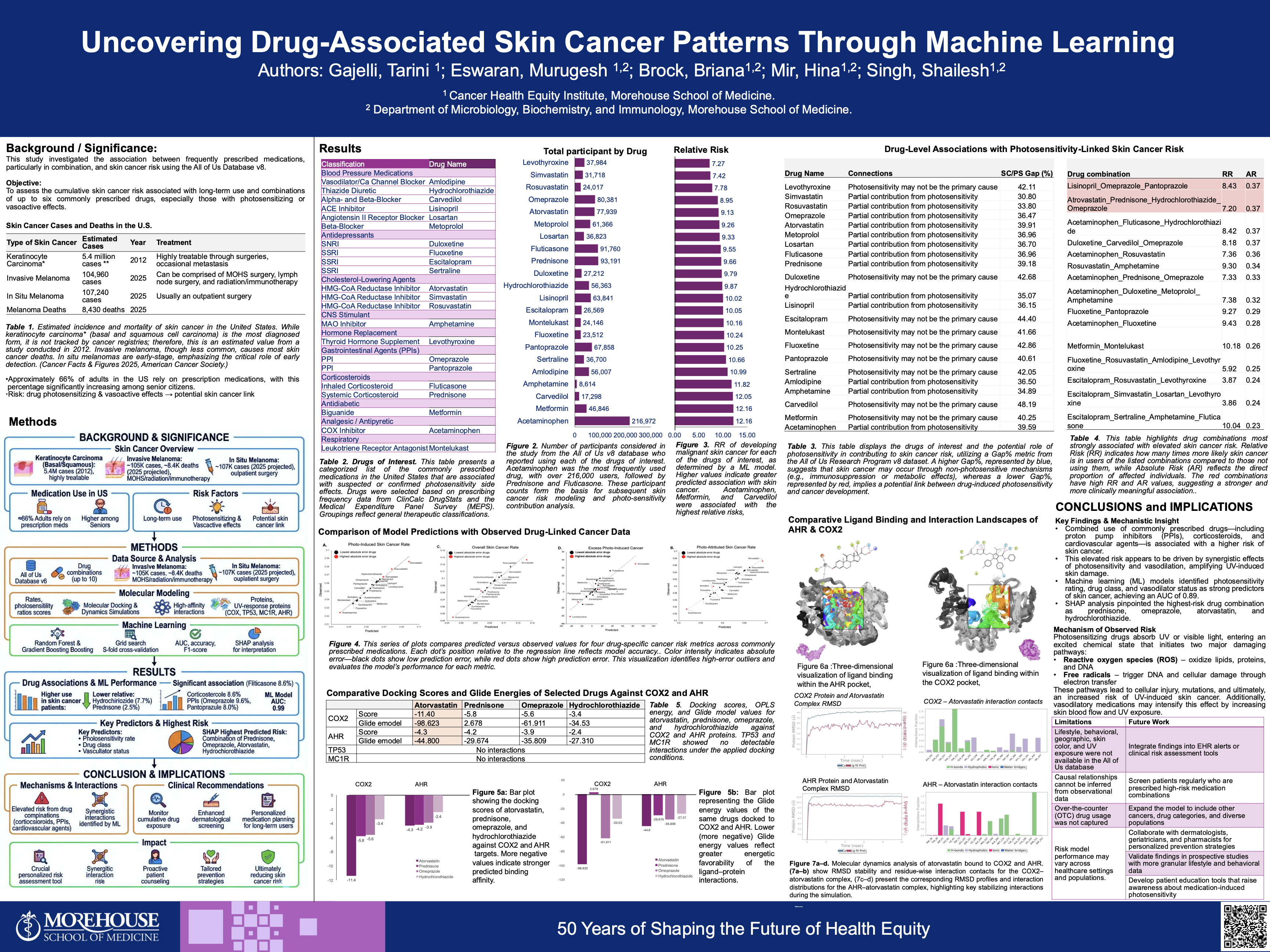
Clinical caution: These findings should not be used to stop, start, or change any medication. Confounding, exposure duration, indication, ultraviolet exposure, lifestyle, geography, ancestry, healthcare utilization, and other factors require further evaluation.
SKIN CANCER
Skin-cancer survey results
Age when first diagnosed
Currently receiving treatment
Still seeing a healthcare provider
Family members reported
| Self | 45 |
| Mother | 29 |
| Father | 22 |
| Sibling | 22 |
| Grandparent | 14 |
| Daughter | 3 |
Select-all question; responses are not mutually exclusive.
CHRONIC SKIN CONDITIONS
Eczema and psoriasis survey results
Age when first diagnosed
| Child (0–11) | 12 · 20.0% |
| Adolescent (12–17) | 9 · 15.0% |
| Adult (18–64) | 35 · 58.3% |
| Older adult (65–74) | 3 · 5.0% |
| Elderly (75+) | 1 · 1.7% |
Currently receiving treatment
Still seeing a healthcare provider
Family members reported
| Self | 60 |
| Daughter | 21 |
| Sibling | 16 |
| Mother | 14 |
| Son | 11 |
| Father | 9 |
| Grandparent | 5 |
Select-all question; responses are not mutually exclusive.
STUDY DATA
Download filtered data
Each file contains only skin-cancer, eczema, psoriasis, or other skin-condition records extracted from the larger aggregated survey analysis.
LIMITATIONS
Responsible interpretation
- The information is aggregated and self-reported, not verified clinical-record data.
- The skin-cancer follow-up group is small and racially imbalanced; subgroup comparisons are exploratory.
- Family-history questions allow multiple selections, so their counts cannot be summed as unique participants.
- The treatment questions indicate only yes or no; treatment type, response, duration, and outcome are unavailable.
- Adjusted regression and causal conclusions require participant-level data and appropriate approvals.